The growth of women’s football in recent years has been extraordinary. Increasingly, clubs, coaches, and fitness trainers are adopting a professional methodology tailored to the specific characteristics of female players, understanding that success depends not only on talent but also on good planning, communication, and team cohesion.
In this article, we will explore the main training strategies in women’s football, covering physical, technical, tactical, and mental preparation, to optimize performance and strengthen team unity.
🧠 Training in women’s football: understand before planning
The first step to effectively coaching a women’s team is to understand its particularities. While the training model must be demanding, there are biological, physiological, and social factors that should be considered:
- Hormonal differences and body composition, which can influence strength and recovery.
- Menstrual cycle, which affects load planning and effort management.
- Psychological and motivational aspects, where empathy and communication from the coaching staff are key.
🏋️♀️ Physical preparation: strength, prevention, and sustainable performance
Physical preparation in women’s football aims to improve performance and prevent injuries, especially those more common in women, such as anterior cruciate ligament injuries.
🔹 Key points in physical preparation
- Structural strength training:
- Prioritize exercises such as squats, deadlifts, unilateral work, and eccentric training.
- Fundamental for stability, power, and injury prevention.
- Load control and prevention:
- Use tools like GPS or RPE (rate of perceived exertion) to adjust intensity.
- Alternate high-demand sessions with active recovery days.
- Speed and power:
- Short sprints, changes of pace, starting and stopping work.
- Improve reaction capacity and explosive actions, which are decisive in the game.
💡 Physical training should be integrated with technical and tactical work, not separated from it.
⚙️ Technical-tactical training: building a game with identity
Tactical and technical development is what makes the difference between teams. In modern women’s football, the goal is to create a clear game identity adaptable to different competitive contexts.
🔹 How to design effective tasks
- Real game situations that connect training with competition.
- Small spaces, ideal for fostering decision-making and communication.
- Progressive difficulty, moving from guided tasks to more free and contextual exercises.
🔹 Practical examples
- 6×6 possession + jokers: encourages mobility and game reading.
- 4×3 attacks with transition: works offensive speed and defensive recovery.
- Mid-block pressing: reinforces coordination and defensive organization.
🧩 Cohesion and communication: the team’s invisible strength
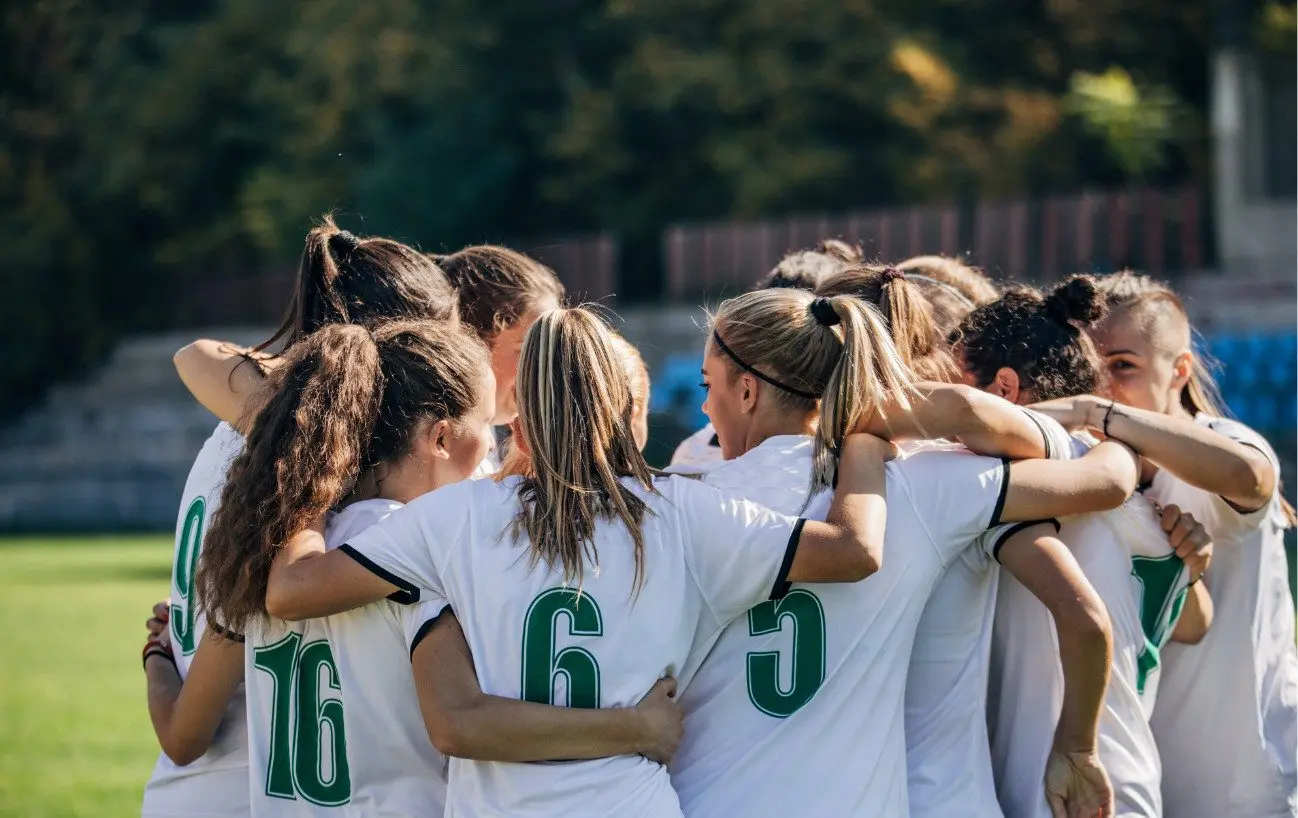
One of the greatest strengths of women’s football is cohesion and collective work. Emotional connection between players improves performance and the ability to compete in difficult moments.
🔹 How to enhance group cohesion
Off-field dynamics that reinforce trust and a sense of belonging.
Defined roles, where each player understands her function within the team.
Shared leadership, promoting collective responsibility.
Positive feedback, to reinforce confidence and motivation.
A player who feels heard and valued performs better and commits to the group.
🧘♀️ Mental preparation: the key to high performance
Psychological preparation is now a fundamental pillar in professional women’s football. Teams like FC Barcelona or the Spanish national team stand out for their mental strength and ability to maintain focus under pressure.
🔹 Key points of mental work
- Emotional management: learning to handle frustration or mistakes.
- Match visualization: helps anticipate scenarios and decisions.
- Pre-competition routines: reinforce self-confidence and mental stability.
- Resilience training: accept challenges and turn them into learning opportunities.