
Preseason in football is much more than a phase of physical preparation. It is the key moment to build the performance foundation that will support the team throughout the season. However, a common mistake is overloading players, which can lead to injuries, premature fatigue, or loss of motivation.
The challenge lies in finding the balance: designing an intelligent preseason where strength, speed, and endurance are trained in an integrated and progressive way, without compromising players’ health.
📌 Why talk about an “intelligent” preseason?
In the past, preseasons focused almost exclusively on running volume and aerobic endurance. Today, we know that this approach does not reflect the real demands of football—a high-intensity sport with changes of pace, accelerations, contacts, and intermittent efforts.
A modern preseason should:
- Integrate strength, speed, and endurance.
- Prevent injuries through progressive loads.
- Respect recovery times.
- Prepare the player both physically and mentally.
👉 The goal is for the player to arrive at the start of the competition in their best condition, without unnecessary wear and tear.
🏋️♂️ The role of strength in preseason
Strength is the foundation of physical performance in football. A strong player is more resistant to injury and can perform high-intensity actions more efficiently.
Key exercises:
- Squats and unilateral variations.
- Romanian deadlifts for the posterior chain.
- Plyometric jumps (box jumps, drop jumps).
- Resistance band work to prevent hamstring injuries.
👉 Strength should not be worked only in the gym: combining it with football-specific movements facilitates transfer to the pitch.
🏃♂️ Speed: training more than just acceleration
Modern football requires reaction speed, decision speed, and movement speed. Training speed in preseason is not limited to short sprints but requires a global approach.
Ways to work on speed:
- Repeated sprints of 10–30 meters.
- Start exercises with visual or auditory stimuli.
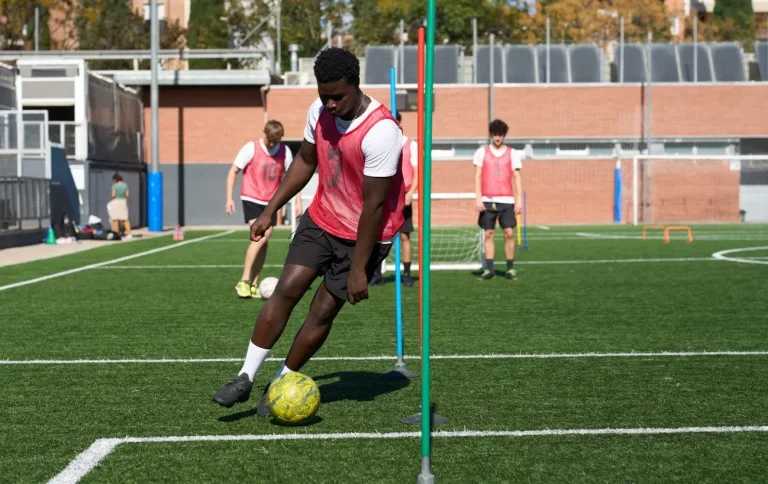
- Changes of direction with the ball.
- Small-sided games that require quick responses.
👉 Speed training should be performed in a fresh state, avoiding prior fatigue to not alter running technique.
💪 Endurance: beyond running long distances
Football requires specific endurance based on intermittent efforts of varying intensity. Therefore, in preseason it is better to prioritize exercises with the ball and conditioned games over traditional long runs.
Recommended methods:
- HIIT on the field: intervals of 15–30 seconds of intense running with active breaks.
- Small-sided games: 4v4, 5v5 with rules that increase physical demand.
- Integrated exercises: possession drills with touch limits to raise intensity.
👉 Working endurance in a contextualized way facilitates transfer to real matches.
⚖️ How to combine strength, speed, and endurance
The real challenge of an intelligent football preseason is integrating the three capacities without overloading the player.
Example of a weekly microcycle:
- Day 1: General strength + short-speed work.
- Day 2: Intermittent endurance with the ball.
- Day 3: Light tactical session + recovery.
- Day 4: Specific strength + high-intensity small-sided games.
- Day 5: Speed + match simulation.
- Day 6: Friendly match or field session with competitive load.
- Day 7: Active rest or recovery.
👉 The key is to alternate stimuli and ensure the player has recovery time between high-load sessions.
🚫 Common mistakes in preseason
- Overloading with running volume without the ball.
- Not progressing loads adequately.
- Ignoring preventive strength work.
- Failing to plan recovery and rest.
- Disconnecting physical work from tactical and technical work.
Unbalanced planning not only reduces performance but also increases the risk of injury in the first league matches.
✅ Conclusion
Preseason should not mean “accumulating kilometers.” An intelligent football preseason combines strength, speed, and endurance in a balanced, contextualized, and progressive way.
The result: better-prepared players, fewer injuries, and sustainable performance.